Central Florida Hurricane Protection
Bahama & Colonial Shutters
Explore two distinctive shutter styles and learn which may suit your home's appearance, openings, and storm-preparation needs.
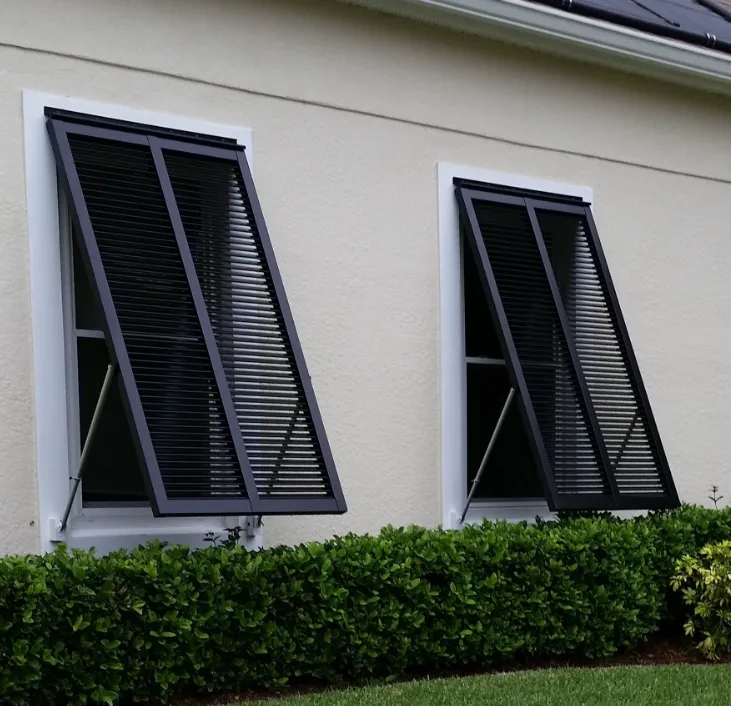
Product visualization — not a completed installation photograph.
Your Main Questions, Answered
Straight answers first. Some details genuinely depend on your openings, and those are marked so you know what still has to be checked at your home.
What is the difference between Bahama and Colonial shutters?
The hinge position. A Bahama shutter is hinged along the top of the opening and props outward from the bottom, so it sits above the window like an awning when it is open. A Colonial shutter is hinged at the sides in two leaves that swing in against the opening and meet in the middle when closed. That single difference drives almost everything else — how they look, how they are closed, and how much clear space each one needs.
Are these hurricane-rated systems or decorative shutters?
Both exist, and they are not the same thing. A decorative shutter is an appearance product only and is not storm protection. A tested, approved Bahama or Colonial system is storm protection, and what makes it so is the documented approval and the engineering drawings it is installed to. We will tell you plainly which one we are quoting for your home, and we do not describe a decorative shutter as hurricane protection.
Confirmed at your property assessment: We confirm in writing, before you decide, whether the shutter quoted for each opening is an approved storm system or a decorative one.
What do they look like open and closed?
A Bahama shutter is visible above the opening all year: propped outward when open, and lowered flat against the opening when closed. A Colonial shutter sits folded back flat against the wall on either side of the opening, and the two leaves swing across to meet in the middle when closed. Both styles remain part of the front of your home every day, which is usually why homeowners choose them.
What does preparing and securing them involve?
Both styles are already on the openings, so nothing is carried out of storage. Closing them is a hands-on job done from outside at each opening, and each opening takes its own time. We do not describe it as effortless, and how long a whole home takes depends on how many openings you have and how easy each one is to reach.
Confirmed at your property assessment: We walk your openings with you and are frank about which ones would be awkward for you to close yourself.
Will they suit my openings and mounting surfaces?
It depends on the opening size, on what the shutter can be fastened to — the wall material and the framing behind it — and on the clear space around the opening. A Bahama shutter needs room above the opening and space to swing outward; a Colonial shutter needs clear wall on both sides for the leaves to fold back into. The approved system's own size limits also apply, and they differ by style. We will not tell you every opening on your home can take either style.
Confirmed at your property assessment: We measure each opening and check the mounting surface before anything is quoted or ordered.
How could they affect daylight and views?
When closed, both styles cover the opening, so the room behind is much darker. When open, a Bahama shutter sits above the window and shades the top of it, which some homeowners like and some do not; a Colonial shutter sits to the sides and leaves the glass itself clear. We do not publish a shading or light-reduction figure for either style, because that is specific to the system, the opening and the angle it is set at.
What affects price and maintenance?
Price: the style, the number and size of openings, whether an approved storm system or a decorative shutter is specified, the mounting surface and any reinforcement it needs, access and height, and whether permitting is included. Maintenance: rinsing, keeping hinges and fasteners sound, and checking that everything still sits and closes as it should. You get a written estimate for your actual openings rather than a price per opening over the phone.
Compare the Two Styles
The two styles are separate products with separate approvals. This table sets out the differences we can state for certain; sizes, hardware, colours and approved limits are specific to the exact system quoted for your home and are confirmed from its documentation.
Bahama shutters
- Hinge position
- Hinged along the top of the opening.
- Appearance when open
- Propped outward from the bottom, sitting above the window like an awning.
- Appearance when closed
- Lowered flat down against the opening.
- Closing it
- Released and lowered at each opening, from outside, one opening at a time.
- Space the opening needs
- Clear space above the opening, and room for the shutter to project outward when open.
- Effect on the glass when open
- Shades the upper part of the window, because the shutter sits over it.
- Approvals
- Covered by their own approval document. Nothing is shared with the Colonial system.
Colonial shutters
- Hinge position
- Hinged at the sides, in two leaves.
- Appearance when open
- Folded back flat against the wall on either side of the opening.
- Appearance when closed
- Both leaves swung across to meet in the middle of the opening.
- Closing it
- Both leaves swung closed and secured at each opening, from outside.
- Space the opening needs
- Clear wall on both sides of the opening for the leaves to fold back onto.
- Effect on the glass when open
- Leaves the glass itself clear; the shutters sit beside the opening.
- Approvals
- Covered by their own approval document. Nothing is shared with the Bahama system.
Where Bahama & Colonial Shutters Fit Best
Homeowners usually come to these two styles because the front of the house matters to them. Which one suits you is mostly a question of the look you want and the space around your openings.
Situations they suit
- Homes where the appearance from the street is as important as the protection itself.
- Bahama style: homes with a coastal or island look, and openings with clear space above them.
- Colonial style: homes with a traditional look, and openings with clear wall on both sides.
- Homeowners who would rather never carry or store a panel.
- Communities and associations that prefer shutters which read as part of the architecture.
Practical tradeoffs
- Both styles are visible on the home every day of the year, open or closed.
- Closing up is done outside, opening by opening — it is not a single action for the whole home.
- The available styles, sizes and mounting details are limited by the approved system, and they differ between Bahama and Colonial.
- A decorative shutter is not storm protection; if protection is the goal, an approved system is required and it costs more.
- Cost depends on your openings and on which style and system are specified, so the two are not directly interchangeable on price.
Another product is sometimes the better fit. We compare them with you for your actual openings rather than naming a single best product.
- Accordion shutters: Permanently installed beside the opening and drawn across when a storm approaches. Usually chosen when closing up quickly matters more than the look from the street. Read about accordion shutters
- Roll-down shutters: Retract into a housing above the opening and lower when needed. Often chosen for large openings and for homeowners who do not want to handle anything at ground level. Read about roll-down shutters
- Storm panels: Removable panels stored between storms. The most economical option, and nothing is visible on the home except the mounting components. Read about storm panels
- UltraShield hurricane screens: A retractable option for suitable outdoor openings such as a lanai or patio, rather than for the street-facing windows these styles are usually chosen for. Read about ultrashield hurricane screens
Real Installation Examples
Bahama and Colonial shutters are kept separate below, even though they share this one product page. Supplied renderings remain labelled as visualizations and are not presented as completed installations.
Bahama Shutters
Field photographs and any labelled visualizations assigned specifically to Bahama shutters.
Photo 1 of 21
Colonial Shutters
Colonial shutters stay in their own group so they are not mixed with Bahama shutter photos.
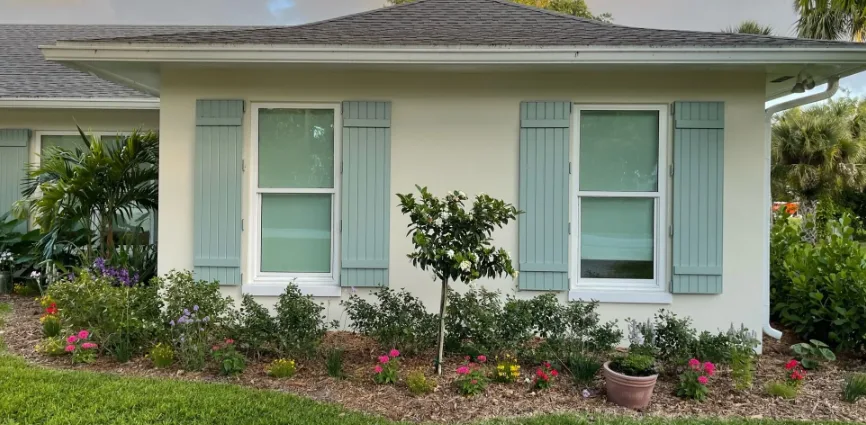
Photo 1 of 5
Product Approvals & Drawings
Choose a Shutter Style
Select a style below to see its product details and approval documents. You can open more than one option to compare.
Installation & Service

Product brand: Bertha
Manufacturer: American Shutter Systems Association, Inc.
Bertha Bahama Shutters
Manufacturer: American Shutter Systems Association, Inc.
Florida's official product-approval record lists the Bertha HV Bahama Shutter (Non-HVHZ), submitted by American Shutter Systems Association, Inc., as approved under FL8523-R10, product number FL8523.1, for the Florida Building Code, Eighth Edition (2023). The engineering drawings, evaluation report and the engineer's Certification of Independence are published here exactly as issued. An approval shows the system was tested and approved — it does not make every opening suitable. That depends on the opening, the supporting structure, the anchorage and the installation requirements in the approved drawings.
Verified benefits
- Top-hinged Bahama shutters that are part of the home's appearance all year and lower over the opening when storm protection is needed.
- The official Florida record lists impact resistance for outside-HVHZ use, subject to the approved drawings and installation conditions.
Suitable uses
- Openings outside the High-Velocity Hurricane Zone where the opening, supporting structure and anchorage match the FL8523.1 approved drawings.
- Homes where a top-hinged Bahama style is preferred and the opening has the clearances the approved system requires.
FL8523-R10 is the Florida Product Approval record (application type: Revision). FL8523.1 is the product number for the Bertha HV Bahama Shutter (Non-HVHZ), drawing 23-139. A High-Velocity Hurricane Zone (HVHZ) is the part of Florida — Miami-Dade and Broward counties — with the state's strictest wind requirements. This record is approved for use outside the HVHZ and is not a Miami-Dade Notice of Acceptance.
- Manufacturer
- American Shutter Systems Association, Inc.
- System
- ASSA/Bertha H.V. Bahama Shutter
- Florida approval
- FL8523-R10 (model FL8523.1)
- Revision
- R10 (application type: Revision)
- Code edition
- Florida Building Code, Eighth Edition (2023)
- Application status
- Approved
- Date approved
- December 12, 2023
- Official record revised
- August 17, 2026
- Document
- Engineering drawings FL8523_R10_II_Drawing 23-139
- Document date
- July 28, 2023
- Product number on the record
- FL8523.1
- Category
- Shutters — Bahama
- Product brand
- Bertha
- Document submitter
- American Shutter Systems Association, Inc.
- Technical system
- ASSA/Bertha H.V. Bahama Shutter
- Official model
- Bertha HV Bahama Shutter (Non-HVHZ) Drawing Number #23-139
- Drawing number
- 23-139
- Evaluation report number
- 23-0728.06
- Where the official record allows it to be used
- Outside the High-Velocity Hurricane Zone: yes. Inside the High-Velocity Hurricane Zone: no.
- Impact and wind-zone notes
- The official record lists impact resistance. The evaluation report states large-missile Level D and small-missile basic protection for ASTM E1996 Wind Zones 1, 2 and 3, subject to the approved conditions. These wind-zone numbers are not hurricane categories.
- Evaluation
- Method 1 Option D evaluation report by Walter A. Tillit, Jr., P.E. (Florida license PE-44167), Tilteco, Inc. / Tillit Testing & Engineering Company
- Material
- Aluminum extrusions, subject to the drawing specifications.
What the document itself says about limits
- These documents cover the Bertha Bahama system for use outside the High-Velocity Hurricane Zone. Suitability depends on your opening, supporting structure, and the approved installation requirements.
- The official record does not establish a Miami-Dade Notice of Acceptance, and this section does not describe the system as HVHZ-approved or Miami-Dade-approved.
- Approved pressures, sizes, anchorage, glass-clearance and fastening conditions are set by the drawings and must be read for the specific opening rather than treated as universal values.
- The drawings are generic and not site-specific. Conditions outside them need separate site-specific sealed engineering.
- The drawings instruct owners to secure the shutters with sill brackets during hurricane warnings. An open shade position is not the prescribed storm-protection position.
- This Bahama approval applies only to the Bahama system named here. It does not cover Colonial shutters or decorative shutters.
Drawing 23-139: the sealed drawings showing system details, approved schedules and installation conditions. The PDF has 12 pages: sheets 1–7 plus 3A, 3B, 4A, 5A and 6A, so a printed sheet label does not always match its PDF page position.
Dated July 28, 2023.
Report 23-0728.06: the technical evaluation for drawing 23-139 and the conditions of use the approval rests on.
Dated July 28, 2023.
The evaluating engineer's statement of financial independence from the company manufacturing or distributing the product. It concerns the engineer's independence only — it is not insurance, a warranty or a separate certification of the product.
Dated July 28, 2023.
Documents are displayed unaltered. The viewer provides no download or print button, but browser saving, screenshots or printing cannot be completely prevented.
Official Florida Approval Record (opens another website)Installation & Service
Product brand: Bertha
Manufacturer: American Shutter Systems Association, Inc.
Bertha Colonial Shutters
Manufacturer: American Shutter Systems Association, Inc.
Florida's official product-approval record lists the Bertha HV Colonial Shutter, submitted by American Shutter Systems Association, Inc., as approved under FL8200-R11, product number FL8200.1, for the Florida Building Code, Eighth Edition (2023). The engineering drawings, evaluation report and the engineer's Certificate of Independence are published here exactly as issued. An approval shows the system was tested and approved — it does not make every opening suitable. That depends on the opening, the supporting structure, the anchorage and the installation requirements in the approved drawings. This is a separate system from the Bertha Bahama shutter, with its own drawings, sizes and fastening requirements; nothing carries across between them. A decorative Colonial shutter is not covered by a storm approval.
Verified benefits
- Side-hinged Colonial shutters that fold back against the wall and swing across the opening when storm protection is needed.
- The official Florida record lists impact resistance for outside-HVHZ use, subject to the approved drawings and installation conditions.
Suitable uses
- Openings outside the High-Velocity Hurricane Zone where the opening, supporting structure and anchorage match the FL8200.1 approved drawings.
- Homes where a traditional side-hinged Colonial style is preferred and there is clear wall on both sides of the opening.
FL8200-R11 is the Florida Product Approval record (application type: Revision). FL8200.1 is the product number for the Bertha HV Colonial Shutter, drawing 23-134. A High-Velocity Hurricane Zone (HVHZ) is the part of Florida — Miami-Dade and Broward counties — with the state's strictest wind requirements. This record is approved for use outside the HVHZ and is not a Miami-Dade Notice of Acceptance.
- Manufacturer
- American Shutter Systems Association, Inc.
- System
- ASSA/Bertha H.V. Colonial Shutter
- Florida approval
- FL8200-R11 (model FL8200.1)
- Revision
- R11 (application type: Revision)
- Code edition
- Florida Building Code, Eighth Edition (2023)
- Application status
- Approved
- Date approved
- December 12, 2023
- Official record revised
- August 11, 2026
- Document
- Engineering drawings FL8200_R11_II_Drawing 23-134
- Document date
- July 21, 2023
- Product number on the record
- FL8200.1
- Category
- Shutters — Colonial
- Product brand
- Bertha
- Document submitter
- American Shutter Systems Association, Inc.
- Technical system
- ASSA/Bertha H.V. Colonial Shutter
- Official model
- Bertha HV Colonial Shutter Drawing Number #23-134
- Drawing number
- 23-134
- Evaluation report number
- 23-0721.30
- Where the official record allows it to be used
- Outside the High-Velocity Hurricane Zone: yes. Inside the High-Velocity Hurricane Zone: no.
- Impact and wind-zone notes
- The official record lists impact resistance. The evaluation report states large-missile Level D and small-missile basic protection for ASTM E1996 Wind Zones 1, 2 and 3, subject to the approved conditions. These wind-zone numbers are not hurricane categories.
- Evaluation
- Method 1 Option D evaluation report by Walter A. Tillit, Jr., P.E. (Florida license PE-44167), Tilteco, Inc. / Tillit Testing & Engineering Company
- Material
- Aluminum extrusions, subject to the drawing specifications.
- Approved structures
- The evaluation report limits installation to wood frame, poured concrete or concrete block structures.
What the document itself says about limits
- These documents cover the Bertha Colonial system for installations outside the Miami-Dade and Broward High-Velocity Hurricane Zone. Suitability depends on your opening, supporting structure, fasteners, configuration and the approved drawing requirements.
- The "H.V." wording in the system name does not make this an HVHZ approval. The record does not establish a Miami-Dade Notice of Acceptance, and this section does not describe the system as HVHZ-approved or Miami-Dade-approved.
- Approved pressures, maximum opening sizes, anchorage, glass clearances and fastening patterns are set by the drawings for each configuration and must be read for the specific opening rather than treated as universal values.
- The drawings are generic and not site-specific. Conditions outside them need separate site-specific sealed engineering.
- The drawings require each shutter to carry a visible marking instructing the owner to secure it with the specified storm bars and safety pins during hurricane warnings. Safe access to secure the shutters should be assessed, especially for elevated openings.
- This Colonial approval applies only to the Colonial system named here. It does not cover Bahama shutters or decorative shutters.
Drawing 23-134: the sealed drawings showing general notes, components, approved schedules and installation conditions. The PDF has 16 pages and the printed sheet labels run 1, 2, 3, 3A and 4 through 14 of 14, so a printed sheet label does not always match its PDF page position.
Dated July 21, 2023.
Report 23-0721.30: the technical evaluation for drawing 23-134 and the conditions of use the approval rests on.
Dated July 21, 2023.
The evaluating engineer's statement of financial independence from the company manufacturing or distributing the product. It concerns the engineer's independence only — it is not insurance, a warranty or a separate certification of the product.
Dated July 21, 2023.
Documents are displayed unaltered. The viewer provides no download or print button, but browser saving, screenshots or printing cannot be completely prevented.
Official Florida Approval Record (opens another website)My Safe Florida Home
My Safe Florida Home is a State of Florida program run by the Florida Department of Financial Services. It offers free wind-mitigation inspections and, for homeowners who qualify, grant assistance toward approved improvements. It is not our program, and we are not part of it.
- This product. The program considers opening protection, and that means a tested, approved storm system — a decorative shutter is not opening protection and would not qualify. Even with an approved Bahama or Colonial system, your home, your wind-mitigation inspection recommendations, the scope of your project and the program's own decision determine eligibility. We cannot promise that your project qualifies or is approved.
- Funding is never guaranteed. Your inspection report and the program decide what, if anything, is funded, and availability changes.
- Do not start work early. If you intend to use grant assistance, construction must not begin before the program has approved your grant. Starting early can disqualify the work.
How it works. You create an account with the program, answer its questionnaire, and are placed in a group. A free wind-mitigation inspection is scheduled, and the inspection report lists the improvements recommended for your home. A grant application follows if you qualify.
What decides eligibility. The program sets the rules — including home type, homestead status, income and age priority groups — and the inspection recommendations and program approval determine what, if anything, is funded.
Our part in it. We are a licensed Florida contractor (Florida Certified Building Contractor CBC1270515). We do not describe ourselves as a program-approved or authorised contractor, and we make no claim of government endorsement. Check the program’s own requirements for the contractor you choose before signing anything.
This link opens the official My Safe Florida Home website (mysafeflhome.com) in a new tab and leaves our website.
Payment Options
Grant assistance and financing are two separate things. Grant assistance comes from the state program described above. Financing is an arrangement between you and a lender.
If paying over time would help, you can look at financing through Enhancify, an outside financing provider. Any amount, term or approval is decided by Enhancify, not by us, so we do not quote rates or monthly payments here.
Explore Financing OptionsThis opens Enhancify’s website in a new tab. You will be leaving our website.
Prefer to talk it through first? Call us at 407-883-1873.
Care and Maintenance
A few simple habits help keep the system ready to operate.
Rinse the shutters and hardware
Salt, sand and dust collect on exterior shutters, especially on the hinges and fasteners. Rinsing with clean water and drying the hardware is the single most useful habit. Follow the cleaning guidance in the documentation for your exact system rather than reaching for a household solvent or an abrasive pad.
Check hinges, fasteners and supports
Look over the hinges, fasteners, and the arms or supports that hold a Bahama shutter open, for looseness, corrosion or damage. These are what carry the shutter, and they are the first thing to check after a storm or a hard summer.
Open and close each shutter before the season
Work every shutter on a calm day, well before hurricane season, with whoever will actually be doing it. A stiff hinge, a missing fastener or an opening that is harder to reach than you remembered is far better discovered in May than in September.
Keep the swing path clear
Planting, screens, light fixtures, hose reels and furniture creep into the space a shutter needs. A Bahama shutter needs room to swing outward and down; a Colonial shutter needs clear wall to fold back onto. Check the path is still clear before you need it.
Watch for nests and obstructions
Mud daubers and other insects build in hinges, tracks and any sheltered recess, and a nest can stop a shutter closing properly. Clearing them before the season is part of getting ready.
Use the guidance for your exact system
Lubrication, hardware and any adjustment come from the manufacturer's documentation for the system installed on your home. We do not publish generic instructions here, because they could conflict with the drawings your permit was issued against. Call 407-883-1873 about anything loose, damaged or missing rather than substituting parts.
Questions People Ask Us
Can a decorative shutter be made into storm protection?
No. Storm protection comes from a system that was tested and approved as a whole — the shutter, its hardware and how it is fastened — and that approval belongs to that specific system. A decorative shutter cannot be upgraded into an approved one by adding hardware to it.
Can I have Bahama on some openings and something else on others?
Yes, and many homes do exactly that. Bahama or Colonial shutters on the street-facing windows, and a different product on the large or awkward openings around the back, is a common and practical combination.
Will these shutters lower my insurance?
We cannot promise a saving. Any credit depends on your insurer, your policy and your wind-mitigation inspection, and it is their decision, not ours. What we can do is give you the documentation for the system installed so your inspector and insurer have what they need.
Do I need a permit?
Hurricane protection generally requires a permit in our area, and the permit is issued against the approved system's documentation and drawings. We handle permitting as part of the project and explain what your jurisdiction requires.
Confirmed at your property assessment: Requirements vary by city and county, so we confirm what applies at your address.
What about HOA approval?
Many associations have rules on shutter style and colour, and some prefer these styles precisely because they read as architecture. We can provide product information and drawings to support your application, but the association makes the decision.
Which style should I choose?
It usually comes down to the look you want and the space around your openings — clear space above for Bahama, clear wall to the sides for Colonial. We measure your openings and show you which styles are genuinely workable on your home before you decide.
More questions, if you want the detail
Open any question below. You can leave several open at once.
Finishes depend on the manufacturer and the exact system specified, and we do not list colours here that we have not confirmed for the system being quoted. We bring the current options for your quoted system when we visit, so you are choosing from what can actually be supplied.
Maximum sizes are set by the approved system and its engineering drawings, and they differ between Bahama and Colonial. We do not publish a size limit here, because quoting one that does not match the system installed on your home would be misleading. We check your measurements against the drawings for the system we would install.
No. The shutter has to be fastened to something the approved system permits, and the mounting requirements are part of the drawings. Block, frame, stucco over wood and hollow or damaged substrates are not equivalent. This is checked at your property before anything is quoted.
It depends on the number of openings, the mounting work each one needs, and the permitting and inspection schedule in your jurisdiction. We give you a schedule for your own project rather than a general figure, and we tell you if something changes.
Call 407-883-1873 and tell us what happened. We look at it, tell you honestly whether it is a repair or a replacement, and use the documentation for your system rather than improvising parts.
Not necessarily, and it matters. Many shutters sold as an appearance product carry no product approval and are not storm protection. The distinction is the approval document for the specific system, which is why we point you to that document rather than to the look of the product.
Find the Right Shutter Style for Your Home
We will walk your openings, show you which styles actually fit, and tell you plainly whether what you are looking at is storm protection or appearance only. No pressure and no obligation.